
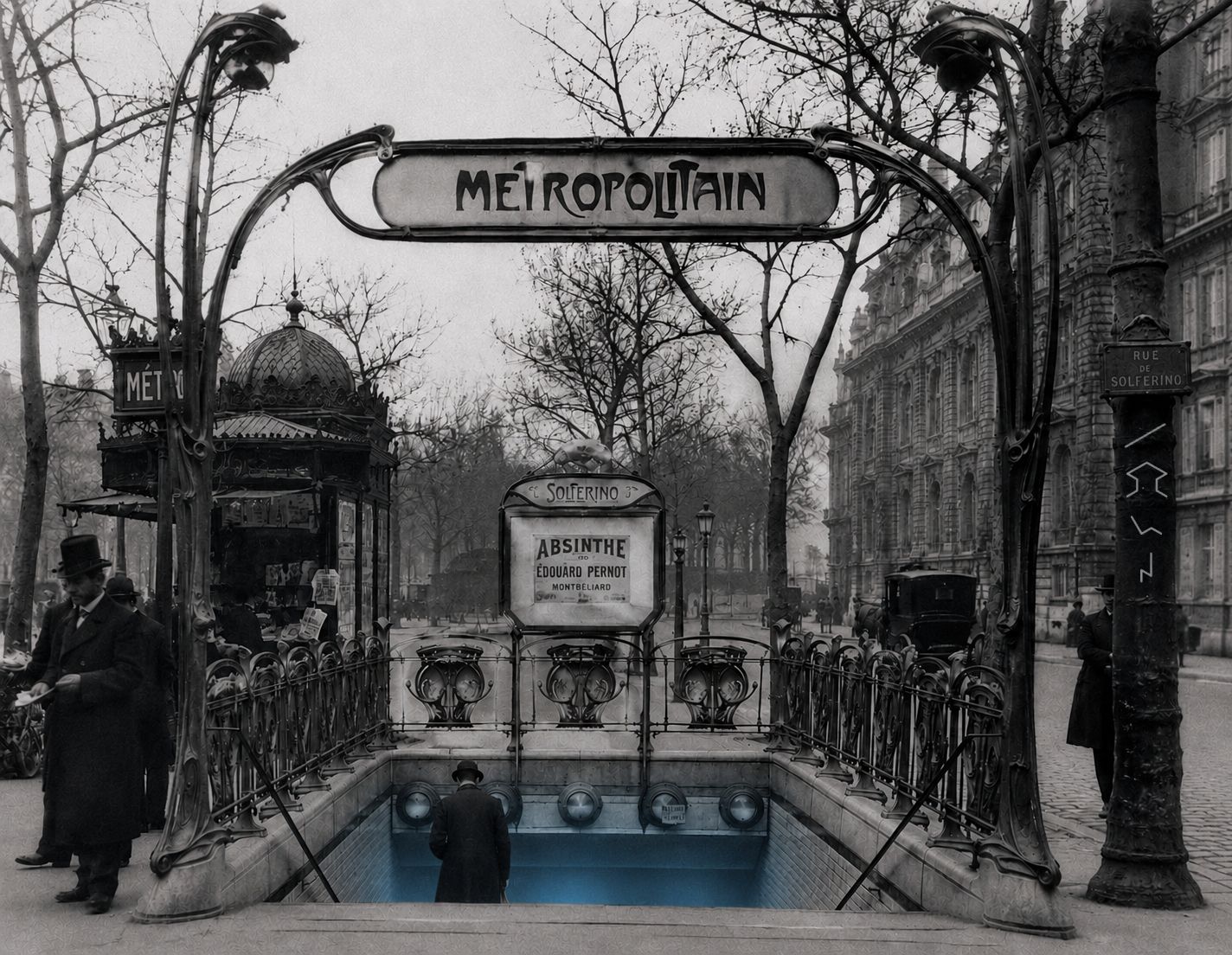
Beneath the streets of Paris, something has endured through the centuries, overcome every challenge, and connected generations while remaining hidden from view. Where every station tells part of the city's story, one network has become one of its greatest symbols: the Paris Metro.
In the mid-19th century, the goal was to serve Paris with an urban railway, as the city was increasingly overwhelmed by surface transport. For decades, the French State and the City of Paris disagreed: the former wanted a large-scale network, while the latter focused on routes within the city walls. As the 1900 World's Fair approached, a visionary project proposed in 1895 by engineer Fulgence Bienvenüe (1852–1936), continuing the transformation begun under Baron Haussmann, led to the final decision in 1898: the network would be underground, electric and built to a smaller gauge. In just twenty months, the "Father of the Metro" oversaw its construction, and Paris achieved an extraordinary engineering feat in time for the 1900 Olympic Games and World's Fair. On July 10, 1900, Line 1 opened, marking the beginning of a new era.
The Metro also reflects the city's hardships. In 1903, a fire at Ménilmontant station claimed 84 lives and forever changed its history. In 1910, its tunnels crossed beneath the Seine, only to be reached days later by the river's historic flood. During World War II, Line 11 was closed and narrowly escaped being converted into an underground weapons factory by the German occupation. Yet through every challenge, the Metro kept moving, driven by the resilience of Paris.
Over the decades, it has never stopped evolving. In 1934, it extended beyond Paris for the first time into the suburbs. In 1948, the Paris Transport Authority (RATP) was created, and in 1956 the world's first rubber-tyred Metro trains entered service, confirming the network's pioneering spirit. Later, in 1998, Line 14 introduced fully automated operation, followed by the historic Line 1 in 2012. For the 2024 Olympic Games, the Metro expanded again, connecting Orly Airport and bringing visitors from around the world even closer to the capital.
More than a means of transport, the Metro is living heritage. Behind its famous Art Nouveau entrances, its stations, platforms and tunnels preserve the memory of millions of passengers, remarkable engineering achievements and the evolution of a city that has never stopped reinventing itself.
Innovation, Heritage, Resilience and Modernity still define this iconic network today. Every train crossing Paris continues a story that began more than 120 years ago, where progress never comes at the expense of memory. Even today, the Metro carries far more than passengers... It carries the soul of Paris.
#YesForParis