
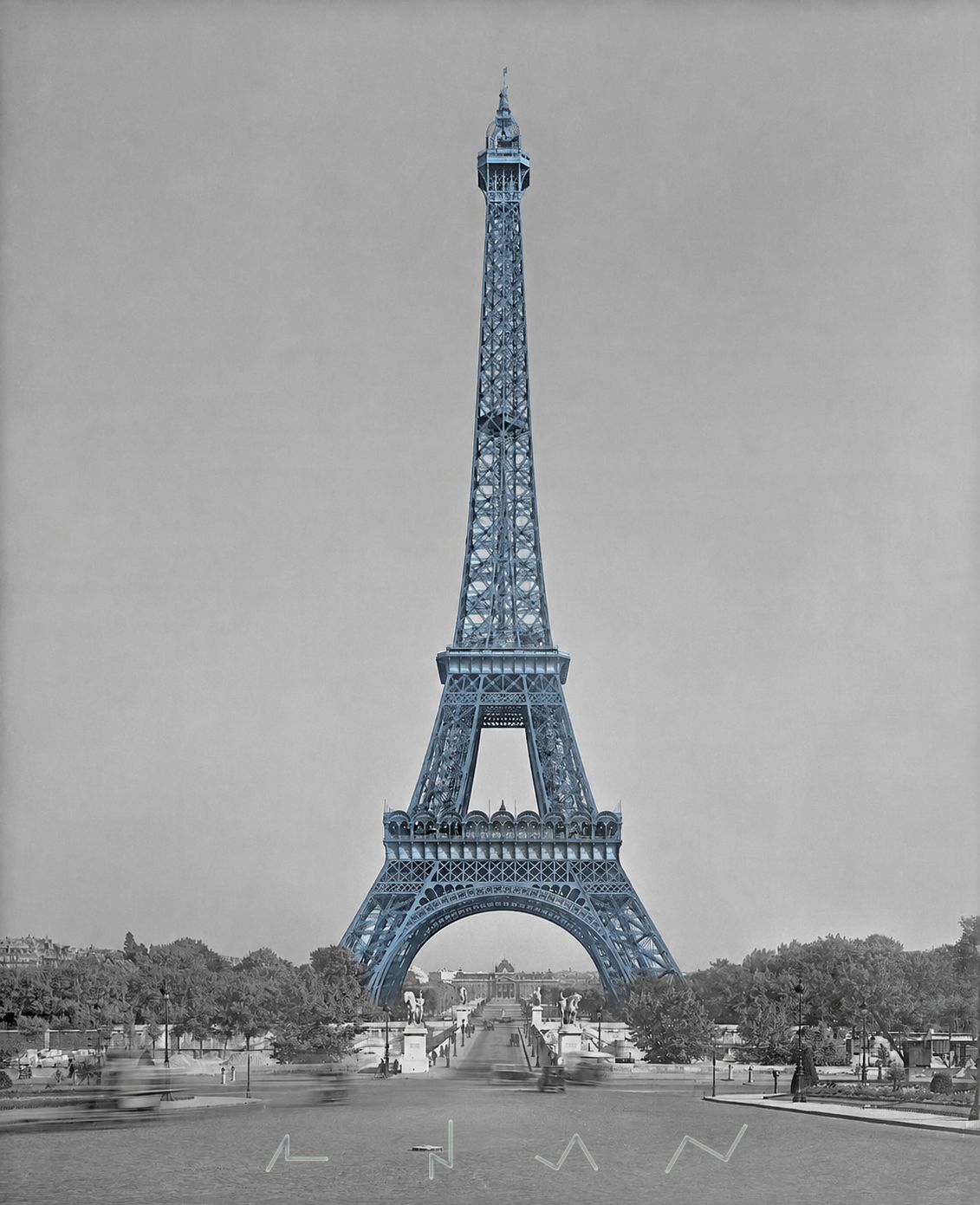
In Paris, there is a silhouette you recognize before you even know where you are. It rises above the rooftops, seems to challenge the sky and recalls the day Paris decided to build the impossible: the Eiffel Tower 🗼.
In 1884, as the 1889 World’s Fair was being prepared, two engineers from Gustave Eiffel’s company, Maurice Koechlin and Émile Nouguier, imagined a 300-meter metal tower. The idea was dizzying: four huge iron pillars would rise from the Champ-de-Mars and meet high in the sky. Architect Stephen Sauvestre then gave the project its curves and elegance.
The project was chosen from 107 proposals submitted to a competition announced in the Official Journal. But as soon as the first plans were revealed, criticism arose. Artists and writers feared that a gigantic metal structure would disfigure Paris. In 1887, a famous “Protest against the Tower of Mr. Eiffel” brought together many leading names from the arts and letters.
Yet Gustave Eiffel did not give up. On January 26, 1887, the first foundations were laid. For two years, two months and five days, workers, engineers and draftsmen assembled 18,038 metal parts, 7,300 tons of iron and 2.5 million rivets. A true challenge when you know that four men were needed to install a single rivet. Each part was made to within a tenth of a millimeter by 150 workers in a factory in Levallois-Perret before being assembled on the Champ-de-Mars. On March 31, 1889, the structure finally reached its summit: 312 meters with its mast and flag, the tallest structure ever built by man.
On May 15, 1889, it opened to the public for the World’s Fair, held to celebrate the centenary of the French Revolution. The controversy faded before the undeniable presence of the finished work and its immense popular success. Nearly two million people climbed its levels within a few months, discovering from above a Paris no monument had ever allowed them to see in quite this way.
Built for a limited lifespan, it was initially meant to disappear after twenty years. Its dismantling was even planned for 1909. Yet Gustave Eiffel found it a new reason to exist. The immense structure became a laboratory for meteorology, aerodynamics and scientific experiments, then above all for wireless telegraphy. At the start of the 20th century, it became a strategic point for radio transmissions, helping save the tower that was meant to be dismantled. The Tower became an antenna, and soon a formidable means of communication.
What was meant to be temporary became permanent. What was meant to disfigure Paris became its emblem. Once considered a metal monstrosity by some, it gradually became the capital’s most photographed silhouette, then one of France’s symbols around the world. Even today, it continues to grow with successive antennas and now rises above 330 meters, remarkable proof that after more than 130 years, this old iron lady has not finished her ascent.
Boldness, Innovation, Perseverance, Transmission: four forces that tell the story of a construction born from a crazy gamble and transformed into a universal symbol. For the Eiffel Tower never merely looked over Paris; it taught Paris to look toward the sky. Will you, in turn, look up and discover what Paris once dared to build?
#YesForParis